
1. Hacer un programa que, dependiendo del número entero ingresado (1 a 12), imprima el mes correspondiente:
                        #include < stdio.h>

                        //To declare the consts of the first and last month.
                        #define FIRST_MONTH 1
                        #define LAST_MONTH 12

                        void main()
                        {
                            //To declare the month variable.
                            int month;

                            //Start the program.....
                            printf("\n\n$$$$$$$$$$$$$$$$$$$$$$$$$$$$$$$$$$$$$$$$$$$$$$$$$\n");
                            printf("$$$$$$$$$$$ MONTHS OF A YEAR $$$$$$$$$$$$$$$$$$$$$$$$\n");
                            printf("$$$$$$$$$$$$$$$$$$$$$$$$$$$$$$$$$$$$$$$$$$$$$$$$$$$$$\n");
                            printf("Please, introduce the number of the month that you want: ");
                            scanf("%d", &month);

                            if((monthLAST_MONTH))
                            {
                                printf("\n\nPLEASE, INTRODUCE A CORRECT NUMBER OF MONTH!!!!\n\n");
                            }
                            else
                            {
                                switch(month)
                                {
                                    case FIRST_MONTH:
                                        printf("\n\nYour introduced month is: JANUARY.\n\n");
                                        break;
                                    case FIRST_MONTH+1:
                                        printf("\n\nYour introduced month is: FEBRUARY.\n\n");
                                        break;
                                    case FIRST_MONTH+2:
                                        printf("\n\nYour introduced month is: MARCH.\n\n");
                                        break;
                                    case FIRST_MONTH+3:
                                        printf("\n\nYour introduced month is: APRIL.\n\n");
                                        break;
                                    case FIRST_MONTH+4:
                                        printf("\n\nYour introduced month is: MAY.\n\n");
                                        break;
                                    case FIRST_MONTH+5:
                                        printf("\n\nYour introduced month is: JUNE.\n\n");
                                        break;
                                    case LAST_MONTH-5:
                                        printf("\n\nYour introduced month is: JULY\n\n");
                                        break;
                                    case LAST_MONTH-4:
                                        printf("\n\nYour introduced month is: AUGUST.\n\n");
                                        break;
                                    case LAST_MONTH-3:
                                        printf("\n\nYour introduced month is: SEPTEMBER.\n\n");
                                        break;
                                    case LAST_MONTH-2:
                                        printf("\n\nYour introduced month is: OCTOBER\n\n");
                                        break;
                                    case LAST_MONTH-1:
                                        printf("\n\nYour introduced month is: NOVEMBER.\n\n");
                                        break;
                                    default:
                                        printf("\n\nYour introduced month is: DECEMBER.\n\n");

                                }
                            }
                        }
2. Crear una calculadora que reciba como entrada dos números enteros, un carácter para elegir la operación (+, -, *, /) e imprima el resultado:
                        #include < stdio.h>

                        void main()
                        {
                            //To declare the two operating variables, the operator variable and the result variable.
                            int a, b, result;
                            char op;
                            //To declare a logical variable for repeating the process if the user has introduced something wrong.
                            int logical = 1;

                            //Start the program and to do the iteration....
                            do
                            {
                                printf("\n\n$$$$$$$$$$$$$$$$$$$$$$$$$$$$$$$$$$$$$$$$$$$$$$$$$\n");
                                printf("$$$$$$$$$$$ CALCULATOR $$$$$$$$$$$$$$$$$$$$$$$$$$\n");
                                printf("$$$$$$$$$$$$$$$$$$$$$$$$$$$$$$$$$$$$$$$$$$$$$$$$$\n");
                                printf("Please, introduce the first operating: ");
                                scanf("%d", &a);
                                printf("Please, introduce the operator: ");
                                scanf(" %c", &op);
                                printf("Please, introduce the second operating: ");
                                scanf("%d", &b);
                                switch(op)
                                {
                                    case '+':
                                        result = a + b;
                                        logical = 1;
                                        break;
                                    case '-':
                                        result = a - b;
                                        logical = 1;
                                        break;
                                    case '*':
                                        result = a * b;
                                        logical = 1;
                                        break;
                                    case '/':
                                        if(b == 0)
                                        {
                                            printf("\n\nSYNTAX SERBIAN ERROR!!!\n\n");
                                            logical = 0;
                                        }
                                        else
                                        {
                                            result = a / b;
                                            logical = 1;
                                        }
                                        break;
                                    default:
                                        printf("\n\nPLEASE, INTRODUCE A CORRECT OPERATOR!!!!\n\n");
                                        logical = 0;
                                }
                            }while(logical == 0);

                            //To print the solution.....
                            printf("\n\n%d %c %d = %d\n\n", a, op, b, result);
                        }
3. Hacer un programa que imprima todos los números del 1 al n:
                        #include < stdio.h>

                        void main()
                        {
                            //To declare the final number variable.
                            int num;
                            //To declare the counter i variable.
                            int i;

                            //Start the program....
                            printf("\n\n$$$$$$$$$$$$$$$$$$$$$$$$$$$$$$$$$$$$$$$$$$$$$$$$$\n");
                            printf("$$$$$$$$$$$ PRINTING NUMBERS $$$$$$$$$$$$$$$$$$$$\n");
                            printf("$$$$$$$$$$$$$$$$$$$$$$$$$$$$$$$$$$$$$$$$$$$$$$$$$\n");
                            printf("Please, introduce your final number: ");
                            scanf("%d", &num);

                            //To do the iterations and to print the results....
                            printf("\n\n");
                            for(i=1; i<=num; i++)
                            {
                                printf(" %d",i);
                            }
                            printf("\n\n");
                        }
4. Hacer un programa que imprima todos los números del 1 al n, que sean divisibles por 3:
                        #include < stdio.h>

                        void main()
                        {
                            //To declare the final number variable.
                            int num;
                            //To declare the counter i variable.
                            int i;

                            //Start the program....
                            printf("\n\n$$$$$$$$$$$$$$$$$$$$$$$$$$$$$$$$$$$$$$$$$$$$$$$$$\n");
                            printf("$$$$$$$$$$$ PRINTING NUMBERS % 3 $$$$$$$$$$$$$$$$\n");
                            printf("$$$$$$$$$$$$$$$$$$$$$$$$$$$$$$$$$$$$$$$$$$$$$$$$$\n");
                            printf("Please, introduce your final number: ");
                            scanf("%d", &num);

                            //To do the iterations and to print the results....
                            printf("\n\n");
                            for(i=1; i<=num; i++)
                            {
                                if(i % 3 == 0)
                                {
                                    printf(" %d",i);
                                }
                            }
                            printf("\n\n");
                        }
5. Crear un programa que sume todos los números del 1 al n:
                        #include < stdio.h>

                        void main()
                        {
                            //To declare the final number variable.
                            int num;
                            //To declare the counter i variable and the sum to add every numbers from 1 until num.
                            int i, sum = 0;

                            //Start the program....
                            printf("\n\n$$$$$$$$$$$$$$$$$$$$$$$$$$$$$$$$$$$$$$$$$$$$$$$$$\n");
                            printf("$$$$$$$$$$$ PRINTING THE TOTAL SUM $$$$$$$$$$$$$$\n");
                            printf("$$$$$$$$$$$$$$$$$$$$$$$$$$$$$$$$$$$$$$$$$$$$$$$$$\n");
                            printf("Please, introduce your final number: ");
                            scanf("%d", &num);

                            //To do the iteration and to add up every number....
                            printf("\n\n");
                            for(i=1; i<=num; i++)
                            {
                                sum += i;
                            }

                            //To print the results....
                            printf("\n\nThe total of the sum is: %d\n\n",sum);
                        }
6. Crear un programa que calcule el factorial de n:
                        #include < stdio.h>

                        void main()
                        {
                            //To declare the entering final number variable.
                            int num;
                            //To declare the counter i variable, and the store variable.
                            int i, store = 1;

                            //Start the program....
                            printf("\n\n$$$$$$$$$$$$$$$$$$$$$$$$$$$$$$$$$$$$$$$$$$$$$$$$$\n");
                            printf("$$$$$$$$$$$ PRINTING THE FACTORIAL $$$$$$$$$$$$$$\n");
                            printf("$$$$$$$$$$$$$$$$$$$$$$$$$$$$$$$$$$$$$$$$$$$$$$$$$\n");
                            printf("Please, introduce your factorial number: ");
                            scanf("%d", &num);

                            //To do the iteration for obtaining the factorial of num.
                            printf("\n\n");
                            for(i=2; i<=num; i++)
                            {
                                store *= i;
                            }

                            //To print the results....
                            printf("\n\n%d! = %d\n\n", num, store);

                        }
7. Crear un programa que imprima todos los números de tres dígitos que sean divisibles por el número que obtengas cuando extraigas el segundo dígito ((ABC)%(AC) == 0)
                        #include < stdio.h>

                        void main()
                        {
                            //To declare the entering final number variable, and the digits one by one.
                            int abc, a, b, c;
                            //To declare the variable without the b digit.
                            int ac;

                            //Start the program....
                            printf("\n\n");
                            printf("$$$$$$$$$$$$$$$$$$$$$$$$$$$$$$$$$$$$$$$$$$");
                            printf("\n");
                            printf("$$$$$$$$$$$$$$ DIVISIBILITY $$$$$$$$$$$$$$");
                            printf("\n");
                            printf("$$$$$$$$$$$$$$$$$$$$$$$$$$$$$$$$$$$$$$$$$$");
                            printf("\nPlease, introduce a number of 3 digits: ");
                            scanf("%d", &abc);

                            //To do the respective operations and iterations. And print the results....
                            a = abc / 100;
                            b = (abc /10) - (a * 10);
                            c = abc - ((a * 100) + (b * 10));
                            ac = (a * 10) + c;

                            if(abc % ac == 0)
                            {
                                printf("\n\n%d is the number that is divisible by %d.\n\n", abc, ac);
                            }
                            else
                            {
                                printf("\n\nChoose other number of 3 digits, please!!\n\n");
                            }
                        }
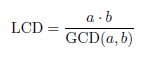
8. Crear un programa que encuentre el máximo común divisor (MCD) y el mínimo común denominador (MCD) de dos números (a y b). El MCD se puede encontrar mediante el algoritmo de Euclides, mientras que el mínimo común denominador se encuentra mediante la fórmula:
                        #include < stdio.h>

                        void main()
                        {
                            //To declare two entering numbers as variables for obtaining the GCD and the LCD. Important to declare a auxiliar variable.
                            int a, b, GCD, LCD, aux;
                            //To declare reminded variables of a and b.
                            int num1, num2;

                            //Start the program....
                            printf("\n\n");
                            printf("$$$$$$$$$$$$$$$$$$$$$$$$$$$$$$$$$$$$$$$$$$");
                            printf("\n");
                            printf("$$$$$$$$$$$$$$$ GCD & LCD $$$$$$$$$$$$$$$$");
                            printf("\n");
                            printf("$$$$$$$$$$$$$$$$$$$$$$$$$$$$$$$$$$$$$$$$$$");
                            printf("\nPlease, introduce the number A: ");
                            scanf("%d", &a);
                            printf("Please, introduce the number B: ");
                            scanf("%d", &b);

                            num1 = a;
                            num2 = b;

                            //To do the respective iterations of the GCD.
                            while(b != 0)
                            {
                                aux = b;
                                b = a % b;
                                a = aux;
                            }
                            GCD = a;
                            LCD = (num1 * num2) / GCD;

                            //To print the results....
                            printf("\n\nThe Greatest Common Divisor (GCD) among %d and %d is %d.\n", num1, num2, GCD);
                            printf("The Lowest Common Denominator (LCD) among %d and %d is %d.\n\n", num1, num2, LCD);
                        }
9. Crear un programa que le pida al usuario un número entero (n) y luego imprima todos los números del 1 al n que sean divisibles por 17:
                        #include < stdio.h>

                        void main()
                        {
                            //To declare a introduced integer number by the user. And to declare the integer counter i for prints out from 1 to num.
                            int num, i;

                            //Start the program....
                            printf("\n\n");
                            printf("$$$$$$$$$$$$$$$$$$$$$$$$$$$$$$$$$$$$$$$$$$");
                            printf("\n");
                            printf("$$$$$$$$ DIVISIBLE NUMBERS BY 17 $$$$$$$$$");
                            printf("\n");
                            printf("$$$$$$$$$$$$$$$$$$$$$$$$$$$$$$$$$$$$$$$$$$");
                            printf("\nPlease, introduce a number: ");
                            scanf("%d", &num);

                            //To do the iterations and to print the results....
                            printf("\n\n");
                            for(i=1; i<=num; i++)
                            {
                                if(i % 17 == 0)
                                {
                                    printf(" %d",i);
                                }
                            }
                            printf("\n\n");
                        }
10. Crear un programa que solicite al usuario un número entero decimal y lo convierta en un número binario:
                        #include < stdio.h>

                        void main()
                        {
                            //To declare the variables.
                            int num, storage_num, binary_num = 0, weight = 1;

                            //Start the program....
                            printf("\n\n");
                            printf("$$$$$$$$$$$$$$$$$$$$$$$$$$$$$$$$$$$$$$$$$$$$$$$$$$$");
                            printf("\n");
                            printf("$$$$$$$$ CONVERTION FROM DECIMAL TO BINARY $$$$$$$$");
                            printf("\n");
                            printf("$$$$$$$$$$$$$$$$$$$$$$$$$$$$$$$$$$$$$$$$$$$$$$$$$$$");
                            printf("\nPlease, introduce a number: ");
                            scanf("%d", &num);

                            storage_num = num;

                            //To do the iterations and print the results...
                            do
                            {
                                binary_num = binary_num + weight * (num % 2);
                                num /= 2;
                                weight = weight * 10;

                            }while(num >= 1);

                            printf("\n\nThe number %d in binary is: %d\n\n", storage_num, binary_num);
                        }
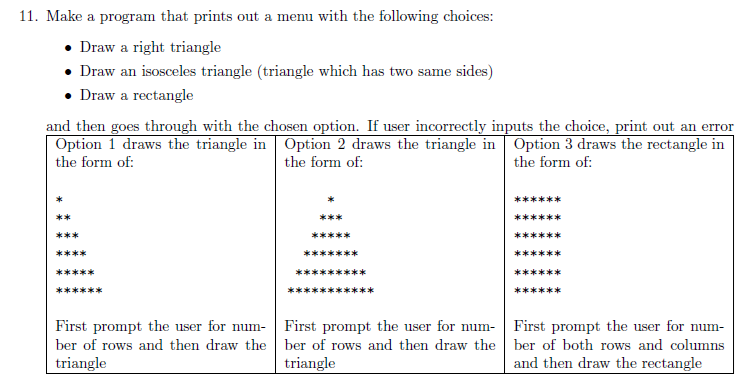
#include < stdio.h>
void main()
{
//To declare the option of the menu variable. The number of cols and rows variables. The counters i and j.
int option, cols, rows, i, j;
//Start the program....
printf("\n\n");
printf("$$$$$$$$$$$$$$$$$$$$$$$$$$$$$$$$$$$");
printf("\n");
printf("$$$$$$$$ Choose the figure $$$$$$$$");
printf("\n");
printf("$$$$$$$$$$$$$$$$$$$$$$$$$$$$$$$$$$$");
printf("\n\n");
do
{
printf("###################################");
printf("\n");
printf("############## MENU ###############");
printf("\n");
printf("###################################");
printf("\n");
printf("# 1. Draw a right triangle. #");
printf("\n");
printf("# 2. Draw an isosceles triangle. #");
printf("\n");
printf("# 3. Draw a rectangle. #");
printf("\n");
printf("###################################");
printf("\nPlease, introduce one option: ");
scanf("%d", &option);
//To do the iterations and to print the results....
switch(option)
{
case 1:
do
{
printf("\n\nPlease, introduce the number of rows (min 2): ");
scanf("%d", &rows);
if(rows < 2)
{
printf("\n\nINCORRECT NUMBER OF ROWS. YOU NEED TO WRITE MORE THAN 1.\n\n");
}
else
{
printf("\n\n");
for(i=1; i<=rows; i++)
{
for(j=1; j<=rows; j++)
{
if(j <= i)
{
printf("*");
}
else
{
printf(" ");
}
}
printf("\n");
}
printf("\n\n");
}
}while(rows < 2);
break;
case 2:
do
{
printf("\n\nPlease, introduce the number of rows (min 2): ");
scanf("%d", &rows);
if(rows < 2)
{
printf("\n\nINCORRECT NUMBER OF ROWS. YOU NEED TO WRITE MORE THAN 1.\n\n");
}
else
{
printf("\n\n");
for(i=1; i<=rows; i++)
{
for(j=1; j < 2*rows; j++)
{
if(j > (rows - i) && j <= rows)
{
printf("*");
}
else if(j < (rows + i) && j > rows)
{
printf("*");
}
else
{
printf(" ");
}
}
printf("\n");
}
printf("\n\n");
}
}while(rows < 2);
break;
case 3:
do
{
printf("\n\nPlease, introduce the number of rows (min 2): ");
scanf("%d", &rows);
printf("Please, introduce the number of cols (min 3): ");
scanf("%d", &cols);
if(rows < 2 || cols < 3)
{
printf("\n\nINCORRECT NUMBER OF ROWS AND/OR COLS. YOU NEED TO WRITE MORE THAN 1 ROW AND MORE THAN 2 COLS.\n\n");
}
else
{
printf("\n\n");
for(i=1; i<=rows; i++)
{
for(j=1; j<=cols; j++)
{
printf("*");
}
printf("\n");
}
printf("\n\n");
}
}while(rows < 2 || cols < 3);
break;
default:
printf("\n\nINCORRECT OPTION. PLEASE, INTRODUCE A OPTION BETWEEN 1 TO 3.\n\n");
}
}while(option < 1 || option > 3);
}
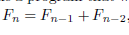
12. Crear un programa que escriba los primeros n números de la secuencia de Fibonacci. Esta secuencia está definida por la imagen, siendo los números iniciales F0 = 0 y F1 = 1:
                        #include < stdio.h>

                        void main()
                        {
                            //To declare the previous, the actual and an auxiliar variable.
                            int pre = 0, actual = 1, aux;
                            //To declare the n numbers that the user wants to introduce by keyboard. And the counter i variable.
                            int n, i;

                            //Start the program....
                            printf("\n\n");
                            printf("$$$$$$$$$$$$$$$$$$$$$$$$$$$$$$$$$$$$");
                            printf("\n");
                            printf("$$$$$$$$ Fibonacci sequence $$$$$$$$");
                            printf("\n");
                            printf("$$$$$$$$$$$$$$$$$$$$$$$$$$$$$$$$$$$$");
                            printf("\n");
                            printf("Please, introduce a number: ");
                            scanf("%d", &n);

                            //Doing the operations and printing the results...
                            printf("\n\nThe Fibonacci sequence is: %d,%d", pre, actual);
                            if(n != 0)
                            {
                                printf(",");
                            }
                            for(i=1; i<=n; i++)
                            {
                                aux = actual;
                                actual = pre + actual;
                                pre = aux;
                                if(i != n)
                                {
                                    printf("%d,", actual);
                                }
                                else
                                {
                                    printf("%d", actual);
                                }
                            }
                            printf("\n\n");
                        }
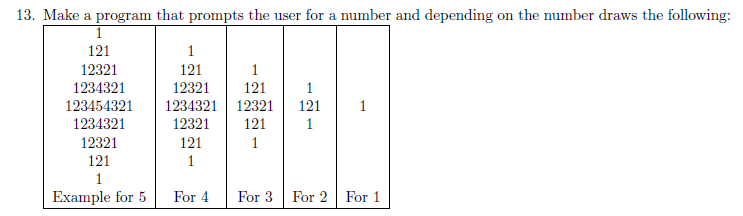
                        #include < stdio.h>

                        #define _CRT_SECURE_NO_WARNINGS

                        void main()
                        {
                            //To declare the number variable, and the counters i and j. And aux variable to print from 1 to num.
                            int num, i, j, blank;

                            //Start the program....
                            printf("\n\n");
                            printf("$$$$$$$$$$$$$$$$$$$$$$$$$$$$$$$$$$$$");
                            printf("\n");
                            printf("$$$$$$$$ DIAMOND OF NUMBERS $$$$$$$$");
                            printf("\n");
                            printf("$$$$$$$$$$$$$$$$$$$$$$$$$$$$$$$$$$$$");
                            printf("\n");

                            //To do the iterations and to print the results....
                            do
                            {
                                printf("\n\nPlease, introduce a number: ");
                                scanf("%d", &num);
                                if(num < 1)
                                {
                                    printf("\n\nINCORRECT: YOU CANNOT INTRODUCE A NUMBER LESS THAN 1.\n");
                                    printf("PLEASE, INTRODUCE AGAIN THE NUMBER.\n\n");
                                }
                                else
                                {
                                    printf("\n\n");
                                    blank = num - 1; //To know the number of blanks that there are.
                                    for(i=1; i<=num; i++)
                                    {
                                        for(j=1; j<=blank; j++)
                                        {
                                            printf(" ");
                                        }
                                        blank--;
                                        for(j=1; j<=i; j++)
                                        {
                                            printf("%d", j);
                                        }
                                        for(j=i-1; j>0; j--)
                                        {
                                            printf("%d", j);
                                        }
                                        printf("\n");
                                    }
                                    blank = 1;
                                    for(i=num-1; i>0; i--)
                                    {
                                        for(j=1; j<=blank; j++)
                                        {
                                            printf(" ");
                                        }
                                        blank++;
                                        for(j=1; j<=i; j++)
                                        {
                                            printf("%d", j);
                                        }
                                        for(j=i-1; j>0; j--)
                                        {
                                            printf("%d", j);
                                        }
                                        printf("\n");
                                    }
                                    printf("\n\n");
                                }

                            }while(num < 1);
                        }
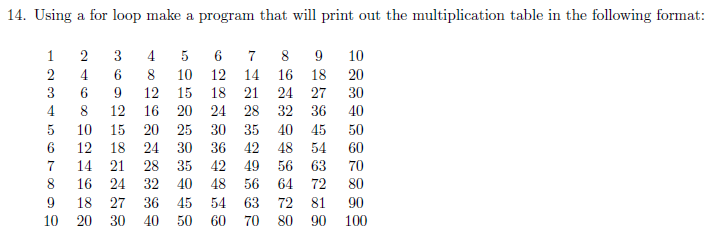
                        #include < stdio.h>

                        #define FINAL_NUM 10

                        void main()
                        {
                            //To declare the counter i and j variables.
                            int i, j;

                            //Start the program....
                            printf("\n\n");
                            printf("$$$$$$$$$$$$$$$$$$$$$$$$$$$$$$$$$$$$$$$$");
                            printf("\n");
                            printf("$$$$$$$$$ MULTIPLICATION TABLE $$$$$$$$$");
                            printf("\n");
                            printf("$$$$$$$$$$$$$$$$$$$$$$$$$$$$$$$$$$$$$$$$");
                            printf("\n");

                            //Doing the operations and printing the results...
                            printf("\n\n");
                            for(i=1; i<=FINAL_NUM; i++)
                            {
                                for(j=1; j<=FINAL_NUM; j++)
                                {
                                    printf("%4.d", i * j); //%4.d is for organizing the table.
                                }
                                printf("\n");
                            }
                            printf("\n\n");
                        }
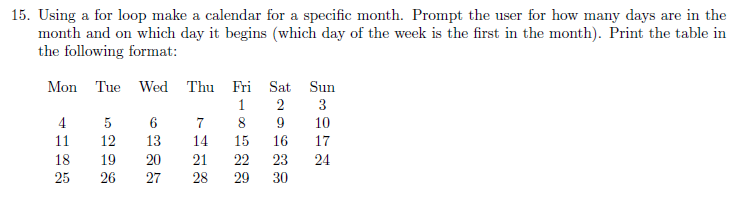
                        #include < stdio.h>

                        void main()
                        {
                            //To declare a variable for days and for names of the week.
                            int days, pos_week;
                            //To declare the counters i and j. And a auxiliar variable to reduce until Sunday.
                            int i, j, aux;
                            //To declare the space character.
                            char space = ' ';

                            //Start the program. Doing the operations and printing the results...
                            do
                            {
                                printf("\n\n");
                                printf("$$$$$$$$$$$$$$$$$$$$$$$$$$$$$$$$$$$$$");
                                printf("\n");
                                printf("$$$$$$$$ CALENDAR OF A MONTH $$$$$$$$");
                                printf("\n");
                                printf("$$$$$$$$$$$$$$$$$$$$$$$$$$$$$$$$$$$$$");
                                printf("\n");
                                printf("How many days does the month have? : ");
                                scanf("%d", &days);
                                if((days < 28) || (days > 31))
                                {
                                    printf("\n\nYou only can introduce the numbers: 28, 29, 30 or 31.\nTRY AGAIN!\n\n");
                                }
                                else
                                {
                                    do
                                    {
                                        printf("###################################");
                                        printf("\n");
                                        printf("######### DAYS OF THE WEEK ########");
                                        printf("\n");
                                        printf("###################################");
                                        printf("\n");
                                        printf("# 1. Monday.                      #");
                                        printf("\n");
                                        printf("# 2. Tuesday                      #");
                                        printf("\n");
                                        printf("# 3. Wednesday.                   #");
                                        printf("\n");
                                        printf("# 4. Thursday.                    #");
                                        printf("\n");
                                        printf("# 5. Friday.                      #");
                                        printf("\n");
                                        printf("# 6. Saturday.                    #");
                                        printf("\n");
                                        printf("# 7. Sunday.                      #");
                                        printf("\n");
                                        printf("###################################");
                                        printf("Which is the first day of the week? : ");
                                        scanf("%d", &pos_week);

                                        if((pos_week < 1) || (pos_week > 7))
                                        {
                                            printf("\n\nTHERE IS NO EXIST THAT DAY OF THE WEEK, SORRY.");
                                            printf("\nTRY AGAIN!\n\n");
                                        }
                                        else
                                        {
                                            aux = pos_week;
                                            printf("\n\n\n");
                                            printf("  Mon Tue Wed Thu Fri Sat Sun\n");
                                            for(i=1; i<=pos_week; i++)
                                            {
                                                if(i != pos_week)
                                                {
                                                    printf("%4.c", space);
                                                }
                                                else
                                                {
                                                    for(j=1; j<=days; j++)
                                                    {
                                                        printf("%4.d", j);
                                                        if(aux == 7)
                                                        {
                                                        printf("\n");
                                                        aux = 1;
                                                        }
                                                        else
                                                        {
                                                            aux += 1;
                                                        }
                                                    }
                                                }
                                            }
                                            printf("\n\n\n");
                                        }
                                    }while((pos_week < 1) || (pos_week > 7));
                                }
                            }while((days < 28) || (days > 31));
                        }
Ubicación: Universidad de Novi Sad - Dr Zorana Đinđića 1, Novi Sad 21000, Vojvodina, Serbia
Teléfono: +381 21 485 2056
Correo electrónico: iro.ftn@uns.ac.rs
Copyright © 2023-2030 My Professional WEB - Todos los derechos reservados